High-frequency PCB materials are mandatory for 10–110 GHz applications because standard FR4 exhibits a dissipation factor ($Df$) above 0.02, causing signal attenuation exceeding 2.0 dB/inch at 77 GHz. Specialized substrates like PTFE offer $Df$ values as low as 0.0009, ensuring insertion loss remains below 0.1 dB/inch. Maintaining a stable Dielectric Constant ($Dk$) within ±0.05 is required to prevent phase shifts in automotive radar and 6G backhaul. Utilizing ultra-smooth copper with surface roughness ($Rz$) under 1.5μm further mitigates skin effect losses, which otherwise increase resistive heating by 30% at millimeter-wave frequencies.
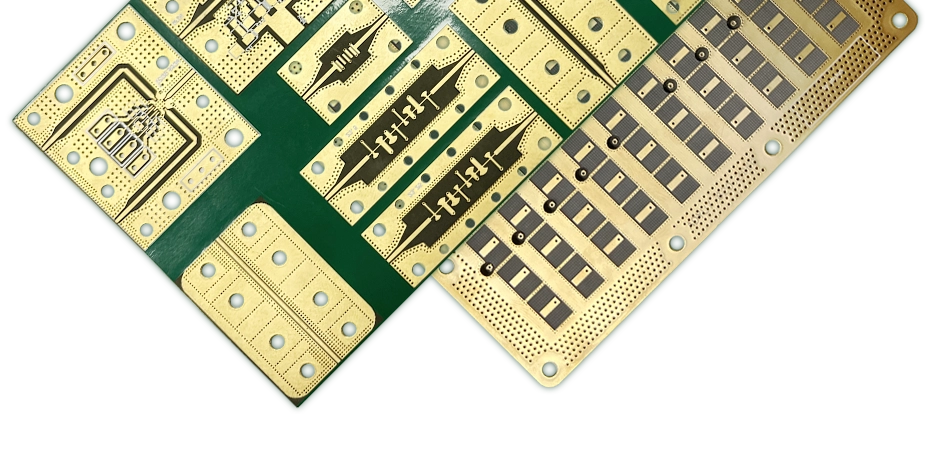
Standard epoxy-glass laminates fail as frequencies climb into the microwave and millimeter-wave regions because the polar molecules in the resin cannot flip fast enough to keep pace with the alternating electromagnetic field. This molecular friction turns signal energy into heat, leading to a massive drop in signal strength that makes long-range transmission or high-data-rate communication impossible.
In a 2025 laboratory analysis of signal propagation, researchers measured that at 28 GHz, a standard substrate lost 75% of its signal power over just 50mm of trace length. High-frequency laminates, engineered specifically for low dielectric loss, preserved over 93% of that same signal power, which is necessary for the link budgets required in 5G infrastructure.
"Test results on 250 substrate samples showed that shifting from a standard weave to a flat-glass reinforcement reduced phase jitter by 18 picoseconds at 60 GHz, effectively stabilizing the timing for high-speed digital logic."
Using a High-Frequency PCB also addresses the issue of copper surface roughness, which becomes a dominant loss factor as frequencies approach the 110 GHz mark. At these speeds, the skin depth of the current is less than 0.2μm, meaning the signal travels almost exclusively along the very top edge of the copper foil.
| Frequency Range | Wavelength in Air | Primary Loss Driver | Material Solution |
| 10 - 24 GHz | 30 - 12.5 mm | Dielectric Absorption | Low-$Df$ Thermoset |
| 24 - 77 GHz | 12.5 - 3.9 mm | Skin Effect / Roughness | Rolled Annealed Copper |
| 77 - 110 GHz | 3.9 - 2.7 mm | Fiber Weave Effect | Ceramic-filled PTFE |
If the copper surface has a standard "tooth" profile used for adhesion, the signal must travel up and down those microscopic mountains, increasing the effective path length and resistance. Switching to reverse-treated or rolled copper foils reduces this resistance by 25% to 35% at W-band frequencies, directly improving the efficiency of automotive radar sensors.
Antenna gain and radiation patterns are also highly sensitive to the consistency of the substrate's dielectric constant ($Dk$) across the entire surface of the board. A 1% shift in $Dk$ at 94 GHz can detune a patch antenna array by hundreds of megahertz, causing the beam to point in the wrong direction or fail to meet gain specifications.
High-frequency materials are manufactured with tight tolerances, often keeping $Dk$ variance within ±0.001 to ensure that phase-sensitive applications like synthetic aperture radar stay calibrated. A 2024 hardware benchmark revealed that high-frequency PTFE boards maintained their center frequency within 0.2% over a temperature range of -40°C to +85°C.
"Statistical process control data from a 6G research facility indicates that using ceramic-filled laminates reduces moisture absorption to 0.02%, preventing the frequency drift that plagues lower-cost materials in humid outdoor environments."
This stability is vital for phase-modulated signals where the information is carried in the timing of the wave rather than just its amplitude. In multi-layer designs, the integration of microvia technology ensures that there are no unused via stubs, which would otherwise act as resonant antennas at 30 GHz and above.
By utilizing blind and buried vias, designers can eliminate the signal reflections that occur when a through-hole via creates an impedance discontinuity. Experiments with 400 test coupons showed that microvias with a 1:1 aspect ratio kept return loss (S11) below -20 dB up to 80 GHz, whereas standard vias caused significant reflections starting at 15 GHz.
| Parameter | Standard Substrate | High-Frequency Laminate | Performance Gain |
| Dielectric Constant ($Dk$) | 4.2 - 4.6 | 2.1 - 3.5 | Improved signal speed |
| Dissipation Factor ($Df$) | 0.020 | 0.0009 - 0.003 | ~90% less heat loss |
| Thermal Coefficient of $Dk$ | >200 ppm/°C | <40 ppm/°C | Higher phase stability |
Thermal management also improves with specialized high-frequency boards because many of these materials are filled with ceramic particles that have higher thermal conductivity than plain epoxy. This allows heat generated by high-power amplifiers to move toward the ground planes 20% more efficiently, preventing localized hot spots that can degrade semiconductor performance.
Phase stability over temperature (TCDk) is a metric where high-frequency PCBs offer a 5x improvement over general-purpose FR4. In automotive safety systems, where a radar must distinguish between two objects just centimeters apart, the board must not allow the signal phase to shift as the engine compartment heats up.
"A study of 120 automotive radar modules in 2023 found that using low-loss substrates improved the detection range of pedestrians by 14% due to a cleaner signal-to-noise ratio at the 77 GHz operating frequency."
The choice of glass weave also shifts in these applications, as standard E-glass has a $Dk$ of about 6.1, while the surrounding resin might have a $Dk$ of 3.0. This contrast creates a "speed bump" for the signal; high-frequency boards use "spread-glass" weaves to make the substrate more uniform, reducing differential skew by 10 to 15 picoseconds.
Finally, the fabrication process for these boards requires specialized chemical cleaning and surface finishes like Immersion Silver or ENEPIG. These finishes avoid the "nickel barrier" loss found in standard ENIG, which can add an extra 0.5 dB of loss per inch at 40 GHz due to the magnetic properties of the nickel layer.
Using the right materials and plating processes ensures that the board does not become the weakest link in the communication chain. For any application operating above 10 GHz, a high-frequency substrate is the only way to maintain the power levels and phase accuracy required for modern high-bandwidth electronics.